Jhumka Styles Explained: Which One Suits Which Occasion
by Jihaan Savla on Aug 29, 2026

Quick answer: A jhumka is a bell-shaped drop earring; the main styles are chandbali (structured, office-to-evening), classic bell/kundan (weddings and festive wear), meenakari (colourful enamel, semi-formal), oxidised (casual, tribal-style) and pearl drop (light, daytime events). Choose by outfit weight: heavy lehengas suit kundan or bell jhumkas, medium outfits suit meenakari or chandbali, and casual wear suits oxidised or pearl drop. Saloni Fashion Jewellery, Mumbai, stocks many of these.
Updated October 2026
Jhumka is one of those categories where the design name matters more than in almost any other jewellery type — a chandbali and a kundan jhumka can both be called "jhumka" by a customer, but they behave completely differently on the ear, on the face, and with an outfit. If you sell jhumkis or wear them, it helps to actually know the differences rather than going by look alone. See our full range under jhumkis.
What is a chandbali jhumka?
The chandbali is technically a variation on the jhumka rather than a pure jhumka — it has a crescent moon-shaped top (chand means moon) that curves along the earlobe, often with a bell-shaped drop below. It reads as more structured and less "swingy" than a classic bell jhumka.
Chandbalis work well for office-to-evening dressing because the crescent shape sits closer to the ear and moves less than a full bell jhumka. They pair naturally with kurtas, saris and Indo-western outfits, and are a good choice for anyone who wants a traditional silhouette without heavy movement.
Classic bell/kundan jhumka
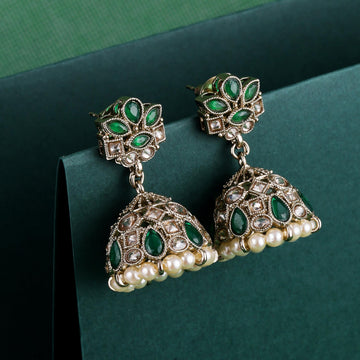
This is the jhumka most people picture first — a rounded, bell-shaped drop, traditionally in gold with a domed top, often set with kundan or coloured stones. The kundan version specifically uses flat-backed glass or stone set in gold-tone metal with a foiled backing that gives the stone its glow, rather than a faceted cut like American diamond.
Kundan jhumkas are occasion pieces first. Their weight and the amount of surface detail make them best suited to weddings, sangeets and festive events rather than daily wear. Pair them with heavier fabrics — silk saris, heavy anarkalis, lehengas — where the earring has visual competition from the outfit and needs the density to hold its own.
Meenakari jhumka
Meenakari is an enamelling technique, not a shape, so you'll see it applied to chandbali, bell and even hoop-style jhumkas. Coloured enamel is fired onto the metal, usually on the reverse or edges of the piece, giving a layered, colourful look often in combinations of pink, green, blue and gold.
Because meenakari brings its own colour, it works best when the rest of the outfit is relatively simple in pattern — solid-coloured or lightly printed fabrics let the enamel work show rather than compete with it. Meenakari jhumkas suit festive and semi-formal occasions and are popular in both traditional and Indo-western pairings.
Oxidised jhumka
Oxidised (blackened silver-tone) jhumkas are a different aesthetic altogether — textured, tribal-influenced, often with bells, coins or beads that create movement and sound. The oxidised finish is achieved by deliberately darkening the metal surface, which gives it a matte, antique look rather than the shine of gold or rhodium plating.
These work particularly well with cotton and linen fabrics, block prints, and casual-to-semi-formal Indo-western wear. Oxidised jhumkas have become a go-to for college-age and younger buyers precisely because they don't read as "formal jewellery" the way gold-tone pieces do.
Pearl drop jhumka
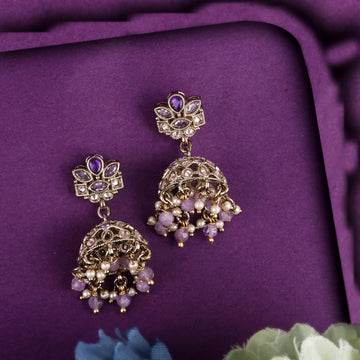
Pearl drop jhumkas combine a smaller jhumka bell or dome with hanging pearl strands or clusters below. They sit at the lighter, more understated end of the jhumka spectrum and photograph well for daytime events — engagements, day weddings, and gifting occasions where a full bridal set would be too much.
Because pearls read as soft and neutral, this style pairs with almost any colour palette, which makes it one of the safer jhumka styles to stock or recommend to a customer who isn't sure what they want.
How much do size and weight matter in a jhumka?
Two jhumkas can look identical in a photo and feel completely different to wear. A few things worth checking before buying or recommending a pair:
- Drop length — a jhumka that drops past the jawline draws the eye down and elongates the face; one that sits at or above the earlobe keeps focus higher and suits shorter faces or those who don't want the extra length.
- Weight distribution — a jhumka with most of its weight concentrated in the bell will pull differently on the ear than one where weight is spread across a wider top. For all-day wear (weddings often run 6-8 hours), lighter, well-balanced pieces matter more than size. A kaan chain transfers some of that weight off the earlobe into the hair.
- Back support — screw-backs or push-backs with a wider base handle heavier jhumkas better than simple hooks, which can sag or tilt under weight over a few hours.
Matching jhumka style to face shape
This is a rule of thumb, not a strict formula, but it helps when advising a customer: rounder faces generally suit jhumkas with more vertical drop (classic bell, pearl drop) because the length adds visual definition. Longer or narrower faces often suit chandbali or wider-topped styles, since the horizontal crescent shape adds width rather than length. Our full guide on how to choose earrings for your face shape works through round, square, heart, long and oval faces in turn. Oxidised jhumkas with clusters or wider tops work similarly for narrower face shapes.
Matching jhumka style to outfit weight
As a simple pairing guide: heavy embroidered or embellished outfits (bridal lehengas, heavy silk saris) pair best with kundan or classic bell jhumkas that can visually hold their own. Medium-weight outfits (cotton silk saris, anarkalis, festive kurtas) suit meenakari or medium chandbali. Light, everyday or casual Indo-western outfits suit oxidised or pearl drop jhumkas that don't overpower a simpler look.
Jhumkis are one of our most requested categories from wholesale buyers precisely because the style range covers such different customer needs from one counter. If you stock or plan to stock jhumkis for your own shop, message us on WhatsApp at +91 98705 89560 or see our wholesale page for how we work with retailers.
| Item | Fact |
|---|---|
| Jhumka earrings collection | 58 designs, Rs 319 to Rs 2,099 |
| Shipping | Free across India |
| Dispatch and delivery | Dispatch in 1-2 days; delivery in 4-15 days |
| Returns | Damaged, defective or wrong items reported within 2 days of delivery; Saloni pays return shipping in those cases |
Common questions about jhumkas
What is a jhumka?
A jhumka is a bell-shaped or dome-shaped drop earring, traditionally Indian, where a decorated cup hangs from a stud or hook and swings as you move. The bell shape is the defining feature. The cup can be plain, filled with kundan or stones, enamelled, or hung with pearls and beads, but if it has that hanging bell it is a jhumka. Flat or purely dangling earrings without the cup are not.
Are jhumka earrings heavy to wear?
It varies a lot by size and metal. Small daily-wear jhumkis in light brass or alloy sit comfortably for hours. Large kundan or bridal jhumkas can feel heavy after a full event, because most of the weight is concentrated in the bell and pulls on one point of the earlobe. Check the weight in hand before committing to a long day in a pair, and for bridal wear look for weight spread across a wider top rather than a single dense bell.
How do I stop a heavy jhumka from dragging on my earlobe?
Use a pair with a screw-back or a wide push-back rather than a thin wire hook, so the load is spread. A small earring lifter or support disc that sits behind the lobe takes strain off the piercing hole and keeps the earring facing forward instead of tilting. For very heavy pairs some wearers also add a supportive patch behind the ear. If a piercing hole has stretched over time, leave a gap between heavy-jhumka days.
Can I wear jhumkas with small or stretched earlobe piercings?
Yes, with the right fitting. Small lobes suit lighter, shorter jhumkis so the earring does not hang below the jaw or overwhelm the ear. Stretched or slightly torn piercing holes should stay with light pairs plus a lifter or support disc and skip the heaviest bridal styles until the piercing has settled. A jhumka on a clip-on or hoop fitting is an option if a post is uncomfortable.
How do I store jhumkas so they keep their shape and do not tangle?
Store each pair flat in its own small pouch or compartment, not loose in a shared box where the bells dent each other and any hanging chains knot. Keep them dry and away from humidity so plated pairs do not dull, and clip the two earrings of a pair together so you are not hunting for the partner later. Our guide to packing and storing fashion jewellery covers this for a full collection.
How do I clean gold-plated and oxidised jhumkas?
Wipe gold-plated jhumkas with a dry soft cloth after each wear and avoid liquid polish or water, which strips the plating; the full method is in caring for gold-plated jewellery. Oxidised jhumkas should be kept dry and wiped gently, since hard rubbing removes the deliberate black finish and leaves bright patches. If a pair turns your ear green or grey, that is a skin reaction to the base metal, explained in why fashion jewellery reacts with skin, not dirt.
What is the difference between a jhumka and a chandelier earring?
A jhumka has a single bell or dome as its main drop. A chandelier earring has multiple tiers of stones or drops fanning outward and downward from the top, with no bell. Some pieces blend both, with a chandelier top and small jhumka bells along the lower edge, but a plain jhumka reads as more traditional and a chandelier as more of an evening or Western-leaning style.
Can jhumkas be worn every day or only for occasions?
Small, light jhumkis in gold-tone or oxidised finishes are a common daily-wear choice with kurtas and casual Indian wear. Heavy kundan, bridal and two-side meenakari pairs are occasion pieces, since their weight and detail make them impractical for a working day. A shop is best carrying both ends: a run of light everyday jhumkis that reorder steadily, and a smaller set of statement pairs for wedding season.
Why do some jhumkas cost much more than others?
Weight of metal, the setting work, and the stones. A hollow, light jhumki with basic stones costs a fraction of a dense pair with hand-set kundan, two-side meenakari, or real-look cubic zirconia (see American diamond vs cubic zirconia). More surface detail and more hand-finishing raise both the wholesale cost and how premium the piece looks on the ear.
Which jhumka styles should a new retailer stock first?
Start with light everyday jhumkis in gold-tone and oxidised, which turn fastest and carry a tighter margin comfortably. Add a small run of pearl drop and medium chandbali for semi-formal buyers, then a few statement kundan or meenakari pairs ahead of wedding season rather than year-round. Our guide to ordering wholesale jewellery in India covers minimums and first-order sizing.