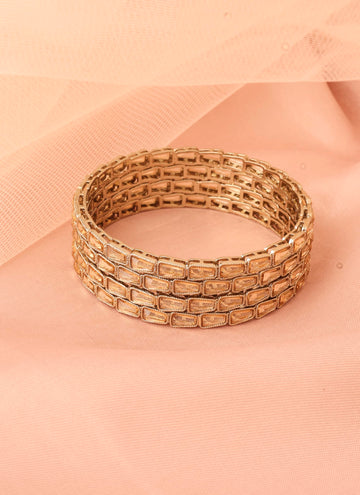
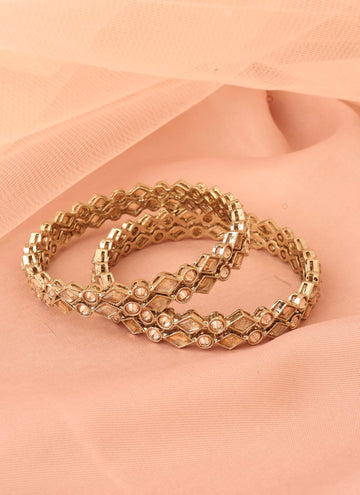
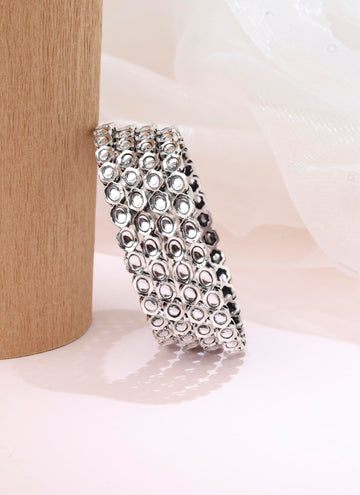
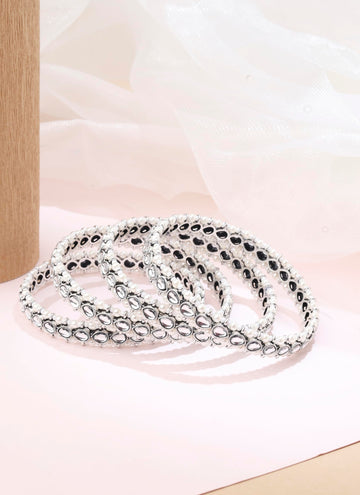
Quick answer: A kada is a broad, solid bangle-style piece, distinct from the thinner stacked bangle and from a Sikh kara (a religious article of faith). Fashion kadas are brass or alloy in gold-tone, silver-tone, antique or oxidised finishes, either openable and adjustable or fully closed and fixed in size. Saloni Fashion Jewellery, Mumbai stocks kadas in gold-plated, antique gold, oxidised and silver finishes.
A kada is one of the simplest-looking pieces in Indian jewellery and one of the most-searched — partly because the word gets confused with a related but different piece of jewellery. This guide covers what a kada actually is, how it differs from a bangle and from a Sikh kara, how to size and open one, and how to keep it looking new. Browse the full range under kadas.
What does the word "kada" mean, and where does it come from?
"Kada" comes from Hindi and Sanskrit roots for a bangle or ring-shaped ornament, and the word is used across North and West India for a broad, solid bangle-style piece, as distinct from the thinner, stacked "bangle" or "choodi". Regional spelling varies — kada, kara, karha — and that overlap is part of why the term gets confused with an unrelated piece of jewellery, covered in the next question.
Is a kada the same as a Sikh kara?
Not quite, though the words are related and often confused. A kara is a plain, unadorned steel or iron bangle worn by many Sikhs as one of the Five Ks, articles of faith with religious significance rather than fashion pieces. A kada, as we use the term, is a decorative wide bangle in fashion metals and finishes — gold-plated, oxidised, kundan-set and so on — worn for style rather than religious observance. If you are looking for a kara specifically, a Sikh jewellery or religious-goods supplier is the right source rather than a fashion catalogue.
What is a kada made of?
In fine jewellery a kada is solid gold or silver, sometimes set with real gemstones. In fashion jewellery, which is what most buyers are shopping for, a kada is brass or alloy with a gold-tone, silver-tone, antique or oxidised plating, and detail work like kundan, CZ or meenakari is added on top rather than being solid stone. The weight and finish are what carry the look, not precious content.
How do you measure your wrist for a kada?
Measuring depends on the style. For an openable kada with an adjustable gap, wrap a tape or paper strip around your wrist, just past the wristbone, the same way you would for a bangle. For a fully closed, non-adjustable kada, measure across your knuckles with your thumb tucked in, since a closed kada has to slide over the widest part of your hand to get on. Our bangle size guide has the full conversion chart if you are sizing several pieces at once.
How do you open and close an adjustable kada safely?
Most adjustable kadas open at a single gap on the underside. Hold the kada with both hands close to the gap and gently pull the ends apart just enough to slip your hand through, rather than prying at one point or bending the whole band. Close it the same way, easing the ends back together rather than snapping them shut. Over-widening the gap repeatedly can weaken the metal at that point over time.
Can a kada be resized?
An openable kada can usually be adjusted within a small range by gently reshaping the gap, but that has limits, and forcing it too far can crack the plating or distort the shape. A fully closed kada generally cannot be resized without cutting and rejoining the metal, which is jeweller's work for solid gold or silver and is not something done on a plated fashion piece — if the fit is wrong, it is more practical to exchange it for the right size.
What is the difference between a kada and a kangan?
The terms overlap regionally and are sometimes used for the same piece. Where a distinction is drawn, "kangan" leans toward traditional or bridal wide bangles, often worn in a pair, while "kada" is used more broadly for a single, sturdy statement bangle, plain or ornamented. Neither word has one fixed definition across India, so the safest approach when buying is to go by the photo and description rather than the name alone.
Do men wear kadas too?
Yes. A plain or lightly detailed kada, usually in oxidised silver, antique gold or a simple polished finish, is common men's jewellery, worn on its own rather than as part of a bridal set. It is a separate thing from the Sikh kara discussed above, though the plain steel look is sometimes echoed in fashion designs. Retailers selling to a mixed customer base often keep a few unisex or masculine-leaning kada designs stocked year-round.
How do you care for a plated kada so it doesn't fade or turn the skin black?
Treat it like any other plated piece: keep it dry, put it on after perfume and lotion have settled, take it off before washing or swimming, and wipe it with a soft dry cloth after wearing. A green or dark mark under the plating is the base metal reacting with skin moisture once the plating wears thin, not a fault — our guide on why fashion jewellery turns skin green or black explains why, and the gold-plated care guide has the full routine.
What should a new retailer stock first in kadas?
Start with plain, adjustable gold-tone and oxidised-silver kadas — they sell to daily-wear buyers and to men's jewellery customers year-round. Add a small run of kundan or meenakari bridal kadas ahead of the wedding and festival season, since those are occasion pieces rather than daily stock. Our wholesale ordering guide covers MOQ and lead times.
Saloni Fashion Jewellery stocks kadas in gold-plated, antique gold, oxidised and silver finishes at our Santacruz West showroom in Mumbai. Retailers, wholesalers, exporters can WhatsApp +91 98705 89560 for wholesale rates, or see the wholesale page.
Not sure whether you want a kada, a bangle or a bracelet? Read bangles vs kada vs bracelet: what is the difference.